- Finance clean energy and climate-related projects that reduce greenhouse emissions.
- Deliver positive economic impact with a particular focus on low-income communities.
- Mobilize private co-financing alongside the public funds.
Developing financial structures to propel clean energy
Financial institutions can support Greenhouse Gas Reduction Fund recipients transitioning to a lower-carbon economy.

By Jeffrey Schub, sustainable finance integration leader at Wells Fargo
July 15, 2024
6-minute read
Private capital providers are ready to dive into one of the largest pools of federal money earmarked for climate solutions. The Greenhouse Gas Reduction Fund (GGRF), a program within the Inflation Reduction Act, is set to play a crucial role in shaping a sustainable, low-carbon future. It provides $27 billion in capital to fund activities that aim to reduce greenhouse gas (GHG) emissions and air pollution, accelerate the deployment of climate and clean energy technologies, and mobilize financing and private capital.
GGRF consists of three programs: the National Clean Investment Fund (NCIF), Clean Communities Investment Accelerator (CCIA), and Solar for All. The majority of the funds — $20 billion in grants — is allocated through NCIF and CCIA, which aims to provide accessible, affordable financing for clean technology projects in partnership with the private sector. The remaining $7 billion is allocated to the Solar for All program, which aims to create opportunities for households in low-income communities to benefit from distributed solar energy.
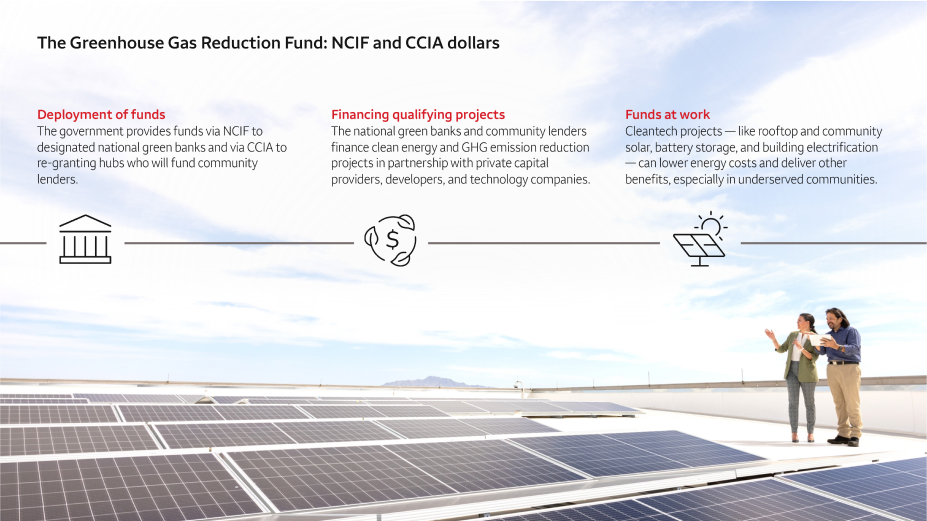
The NCIF and CCIA funds are designed to trickle down to clean energy and climate-related projects across the country from national green banks, community development financial institutions, and a network of nonprofit clean energy-focused lending institutions. However, large banks like Wells Fargo also have a key part to play. NCIF funds must mobilize private co-investment into each qualified project. That way, private capital can begin financing follow-on projects that otherwise would not be addressed.
Exploring the potential impact
In April, the first $20 billion in grants through NCIF and CCIA were awarded to eight nonprofit entities. These awardees can use the funding to directly invest in clean energy projects or to supply community lenders with capital and technical assistance to deploy these projects in their local communities. More than 70% of the funding is expected to go to low-income, rural, and tribal communities.
Objectives of the GGRF grant funds
The scope of projects eligible for GGRF funding is expansive. Winning nonprofit applicants must support priority project categories, such as net-zero buildings, zero-emissions transportation, or distributed energy generation and storage.
Collaborating to unlock opportunities for private investments
While the government is providing $20 billion in the NCIF and CCIA programs, the awardees are expected to use those funds to leverage more private capital to co-invest and participate in emissions-reducing projects. In fact, based on the applications and business plans of the awardees, it is expected that each public dollar will catalyze nearly $7 of private finance. With that, the program is projected to mobilize around $150 billion.
Wells Fargo hosted the first collaborative convening following the government’s announcement to help identify the range of support and infrastructure needed to mobilize GGRF capital. The bank and other private capital providers have a unique opportunity to finance projects, activities, and technologies. GGRF dollars are expected to absorb risk, take first losses, and otherwise participate in structures that will induce private lending and investment. Private capital gets the risk-adjusted returns it needs, and end customers realize economic benefits from clean energy — all possible because of GGRF capital.
Supporting access to sustainable solutions
The broad eligibility for GGRF funding helps to address a wide range of clean energy needs. The legislation requires that at least 40% of the funds are invested in low-income communities. The applicants have all planned to target an even greater percentage of their investments to such communities.
Over the last year, Wells Fargo’s sustainability philanthropy prioritized GGRF-related funding. To help prepare awardees for the inflow of capital, the Wells Fargo Foundation provided grants for technical assistance and capacity building, such as developing clean energy finance products tailored to low- to moderate-income communities.
GGRF presents a unique opportunity for climate-focused financial innovation, collaboration, and inclusion. By fostering public and private sector partnerships, GGRF can help expand access to clean energy solutions and accelerate the transition toward a more sustainable future.